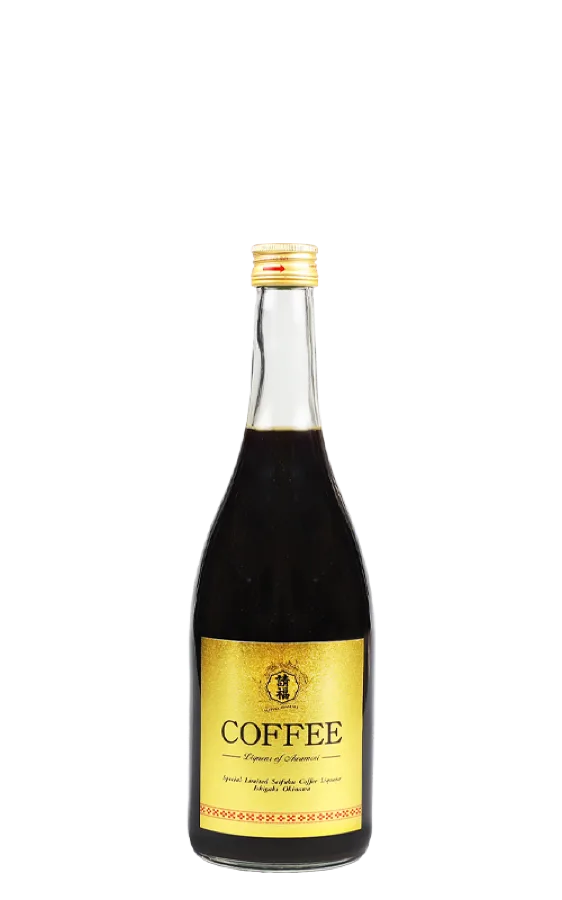
This is a liqueur rather than a base spirit. It is already sweetened, so treat the suggestions below as a starting point and go easier on anything else sweet.
black koji
flavored
liqueur
Pour this first
Soda water, tall over ice. Lemon with it.
These bottles already have one strong flavour in them. Soda gives it room instead of competing with it.
The peel, not the juice: expressed over the top, the oil lifts the roast without turning the drink into a sour. Juice and peel are two different tools. Fresh juice, never bottled, is the whole basis of the lemon sour and the quickest way to put acid into a distilled base. The peel expressed over the top gives the oil and no acid at all, which is what a sweet or roasted bottle usually wants instead.
One part shochu to three or four parts of the long mixer, over plenty of ice, then the accent on top. If it tastes thin, go two to three next time.
What it tastes like
A coffee liqueur built on Seifuku's own awamori rather than a neutral spirit, so the rice base leaves a faint sweetness and a soft, slightly savory foundation underneath the roast. Rich, aromatic coffee finishing smooth and sweet without the syrupy weight most coffee liqueurs carry.
coffee
chocolate
brown sugar
rice
sweet
smooth
Sweet
4/5
Body
3/5
Aroma
4/5
Fruit
not described
Floral
not described
Grain
1/5
Earth
1/5
Umami
1/5
Read from the words above rather than measured. Where it says not described, none of the sources behind this page mention it, which is not the same as it not being there.
Base
awamori made from Yaeyama-grown Hitomebore rice (black koji), with coffee, brown sugar and cocoa powder
ABV
12%
What to mix with it
This bottle is made with coffee, not merely reminiscent of it. A mixer meets the coffee first and the grain second, so read these as answers to the coffee rather than to the barley or the rice. Tap a family to narrow it down. Every suggestion carries its reasoning, so if the reasoning does not convince you, ignore the suggestion.
A longer wedge is a family we'd reach for sooner with this bottle, worked out from its flavours rather than tasted. It isn't a score, or a comparison with other bottles.
Juice and peel are two different tools. Fresh juice, never bottled, is the whole basis of the lemon sour and the quickest way to put acid into a distilled base. The peel expressed over the top gives the oil and no acid at all, which is what a sweet or roasted bottle usually wants instead.
The peel, not the juice: expressed over the top, the oil lifts the roast without turning the drink into a sour
There is real sugar in this bottle already, and acid is what keeps it from reading as syrup.
Acid frames a single strong flavour and keeps it from turning syrupy.
Hoppy Beverage Co. has made it in Tokyo since 1948; at 0.8 percent it is legally a soft drink, and it is hard to find outside Japan. Chill the bottle, the shochu and the mug and no ice is needed.
These bottles already have one strong flavour in them. Soda gives it room instead of competing with it.
Carbonation carries aroma up out of the glass, so a highball shows an aromatic bottle off rather than diluting the point of it.
Bitter orange: sour and aromatic rather than sweet, the citrus that goes into ponzu. Bottled juice is sold for cooking and works straight in a glass. Use the peel too, it carries most of the smell.
There is real sugar in this bottle already, and acid is what keeps it from reading as syrup.
Acid frames a single strong flavour and keeps it from turning syrupy.
Harder to find outside Japan than most of this list. Worth ordering or a trip to a Japanese grocery, and where something easier works as well, that comes first.
A Miyazaki citrus eaten with the white pith left on, which is sweet rather than bitter. Gentler and more floral than lemon, so it flavours a drink without taking it over.
There is real sugar in this bottle already, and acid is what keeps it from reading as syrup.
Acid frames a single strong flavour and keeps it from turning syrupy.
Harder to find outside Japan than most of this list. Worth ordering or a trip to a Japanese grocery, and where something easier works as well, that comes first.
Oita's citrus, softer than sudachi. Bartenders in Oita mix it with the local barley shochu and soda.
There is real sugar in this bottle already, and acid is what keeps it from reading as syrup.
Acid frames a single strong flavour and keeps it from turning syrupy.
Harder to find outside Japan than most of this list. Worth ordering or a trip to a Japanese grocery, and where something easier works as well, that comes first.
Okinawa's own citrus, picked green and sharp, more bitter than lime and more floral than sudachi. Squeezed over awamori and soda it is what the islands actually drink.
There is real sugar in this bottle already, and acid is what keeps it from reading as syrup.
Acid frames a single strong flavour and keeps it from turning syrupy.
Harder to find outside Japan than most of this list. Worth ordering or a trip to a Japanese grocery, and where something easier works as well, that comes first.
A small green citrus from Tokushima, sharper and more herbal than lime. Sold frozen or as juice in Japanese markets.
There is real sugar in this bottle already, and acid is what keeps it from reading as syrup.
Acid frames a single strong flavour and keeps it from turning syrupy.
Harder to find outside Japan than most of this list. Worth ordering or a trip to a Japanese grocery, and where something easier works as well, that comes first.
The Japanese citrus that tastes like grapefruit, mandarin and lemon at once, with a floral peel. A little zest or juice goes a long way.
There is real sugar in this bottle already, and acid is what keeps it from reading as syrup.
Acid frames a single strong flavour and keeps it from turning syrupy.
Harder to find outside Japan than most of this list. Worth ordering or a trip to a Japanese grocery, and where something easier works as well, that comes first.
Food-grade citric and malic powder from the canning aisle, 10 grams whisked into 100 grams of cold water; two parts citric to one malic is close to lime. Some bartenders find a drink with no juice in it thin, so it is worth trying both ways.
There is real sugar in this bottle already, and acid is what keeps it from reading as syrup.
Giffard's white, or Tempus Fugit's, which is a pale brown rather than colourless. Tempus Fugit publishes 24 percent, so on a 25 percent shochu an ounce lengthens rather than fortifies, and on a 40 percent bottle it pulls the strength down.
The cocoa note is already in the tasting notes; this makes it the point of the drink
Cocoa and coffee are one flavour split in two
This mixer is sweetened too, so it lengthens the drink without cutting the sweetness that is already there.
Eden Foods sells it as Ume Plum Vinegar in most US supermarkets, and it is one of the cheapest things on this list. A bar spoon, and unlike a crushed umeboshi it can go into a shaken drink.
There is real sugar in this bottle already, and acid is what keeps it from reading as syrup.
Hot water in the glass first, spirit poured on top so it mixes itself. Around 40C in the glass is the sweet spot. This is not the only way, it is one way.
Water dilutes the botanical without adding anything to argue with it. Useful when the bottle is strong enough that soda would only make it louder.
Sakamoto's, fermented outdoors in earthenware jars in Fukuyama and aged at least a year; Toiro and Japanese Taste ship it in the US. A teaspoon in a mizuwari is the whole intervention, and a second one is usually a mistake.
There is real sugar in this bottle already, and acid is what keeps it from reading as syrup.
Harder to find outside Japan than most of this list. Worth ordering or a trip to a Japanese grocery, and where something easier works as well, that comes first.
Braulio, made in Bormio from gentian, juniper, peppermint and yarrow, around forty-five dollars. A summer drink on shochu and a winter one on whisky, which is one bottle behaving two ways.
Braulio, made in Bormio from gentian, juniper, peppermint and yarrow, around forty-five dollars. A summer drink on shochu and a winter one on whisky, which is one bottle behaving two ways.
Cynar, 16.5 percent, which is weaker than most shochu, so equal parts with a 25 percent bottle lands near 20 and the drink stays long. Soda or a grapefruit soda over the top is the producer's own serve.
Cynar, 16.5 percent, which is weaker than most shochu, so equal parts with a 25 percent bottle lands near 20 and the drink stays long. Soda or a grapefruit soda over the top is the producer's own serve.
Cocchi Americano: moscato steeped with cinchona bark, gentian and bitter orange. The bark is the point of it, and it carries a quinine bitterness no citrus will give you.
Cocchi Americano: moscato steeped with cinchona bark, gentian and bitter orange. The bark is the point of it, and it carries a quinine bitterness no citrus will give you.
Young sansho leaves, clapped between the palms and floated. Hard to find outside Japanese markets in spring, worth the hunt.
Young sansho leaves, clapped between the palms and floated. Hard to find outside Japanese markets in spring, worth the hunt.
Harder to find outside Japan than most of this list. Worth ordering or a trip to a Japanese grocery, and where something easier works as well, that comes first.
Torn leaves steeped briefly. Perfumed citrus without juice.
Torn leaves steeped briefly. Perfumed citrus without juice.
Harder to find outside Japan than most of this list. Worth ordering or a trip to a Japanese grocery, and where something easier works as well, that comes first.
Ways to serve it
Chilled
Straight
On the rocks
With soda
These are shochu with one loud idea in them, shiso or sesame or yuzu. Treat that flavour as the drink's and everything else as its frame, and do not try to add a second loud idea.
Cocktails other people made
We haven't found a cocktail written for this exact bottle. These were written for other bottles, so each one says which, and what changes if you pour this instead.